Adverse event reporting information can be found at the bottom of this page. Click HERE for prescribing information.
EPIDYS study: Primary endpoint
Patients on Duvyzat® experienced lower motor function decline measured by 4SC than control group
Significant difference between Duvyzat® and control from Week 48 through to Week 72
EPIDYS: Observed mean change to complete 4SC test
At the end of the 18-month study period, the log-transformed 4SC GLS mean ratio vs baseline was 1.27 (95% CI: 1.17, 1.37) for Duvyzat® and 1.48 (95% CI: 1.32, 1.66) for the control group (ratio 0.86 [95% CI: 0.745, 0.989], p = 0.035).
Data are mean (95% CI). The confidence intervals have not been adjusted for multiplicity and should not be used for hypothesis testing systemic corticosteroids, in a dose and regimen that was to remain unchanged over the follow-up period. Baseline mean values were 3.39 and 3.48 s for the Duvyzat® and control groups, respectively.
All patients were also receiving systemic corticosteroids, in a dose and regimen that was to remain unchanged over the follow-up period.
EPIDYS study: Secondary endpoints
All key secondary endpoints favoured Duvyzat® vs control, although no statistical significance was reached
Over time, Duvyzat® consistently reduced decline in muscle function and strength as well as fat infiltration
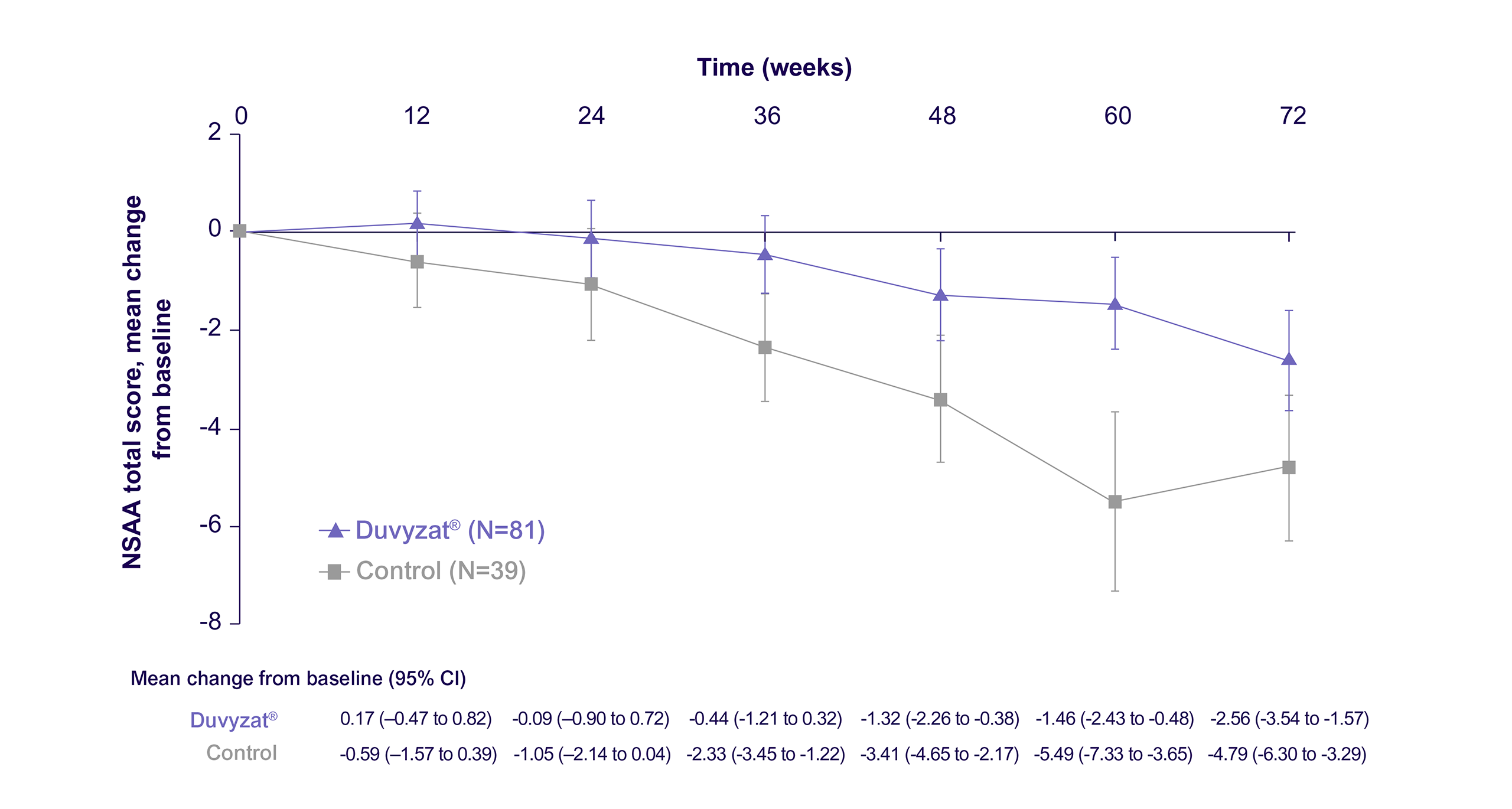
Patients on Duvyzat® experienced a lower functional decline measured by NSAA than control group2
EPIDYS: Observed mean change in NSAA total score from baseline (key secondary endpoint)
The difference from baseline to Week 72 in NSAA total score between the two groups was -1.91 (p = 0.020)
Patients on Duvyzat® experience a lower functional loss over time than control group2
NSAA cumulative loss of function over 72 weeks (key secondary endpoint)
Patients treated with Duvyzat® failed less NSAA items than patients in control group at any time point
The difference from baseline to Week 72 in NSAA cumulative loss of function between the two groups was 2.14
Duvyzat® significantly reduced fat infiltration in the vastus lateralis1, with favourable trends observed in other lower‑limb muscles3
Mean change from baseline over 72 weeks in muscle groups fat fraction
By reducing fat infiltration, Duvyzat® preserves muscle function
VL was the key secondary endpoint1. BFLH, ST, quadriceps, and hamstrings were exploratory endpoints3
Adverse events should be reported. Reporting forms and information can be found at https://yellowcard.mhra.gov.uk/ or search for MHRA Yellow Card in the Google Play or Apple App Store.
Adverse events should also be reported to ITF Pharma Ltd Medical Information on: 0800 098 4040 or UK.Medical.Information@italfarmacogroup.com
Product Quality Complaints should also be reported to ITF Pharma Ltd Medical Information on: 0800 098 4040 or UK.Medical.Information@italfarmacogroup.com
References
Mercuri E, Vilchez JJ, Boespflug-Tanguy O, et al. Safety and efficacy of givinostat in boys with Duchenne muscular dystrophy (EPIDYS): a multicentre, randomised, double-blind, placebo-controlled, phase 3 trial. Lancet Neurol. 2024; 23: 393-403.
Mercuri E, Vilchez JJ, Boespflug-Tanguy O, et al. Safety and efficacy of givinostat in boys with Duchenne muscular dystrophy (EPIDYS): a multicentre, randomised, double-blind, placebo-controlled, phase 3 trial. Lancet Neurol. 2024; 23: 393-403. Supplementary Appendix.
Vandenborne K, et al. Oral presentation at Muscular Dystrophy Association Clinical & Scientific Conference; 19–22 March 2023; Dallas, TX, USA.
Scroll to Top
You are now leaving the ITFrarediseases.co.uk site. ITF Pharma UK is not responsible for the content of any third-party websites.
We encourage you to read the privacy policy of every website you visit.
ITF-RareDiseases is a website exclusively designed for healthcare professionals residing and practicing in the UK. Developed by ITF Pharma UK, this site offers educational content specifically about ITF Pharma products
ITF Pharma UK is legally obliged to restrict access to this website to healthcare professionals only
This website uses technical cookies for operational purposes, as well as analytical cookies, including anonymous third-party cookies, for aggregated statistical analysis. For more details, please refer to our Privacy Policyand Cookies Policy.
UK-DVZ-25-00003 Date of Preparation: May 2025
Registered office ITF Pharma Ltd 27 Old Gloucester Street London WC1N 3AX